
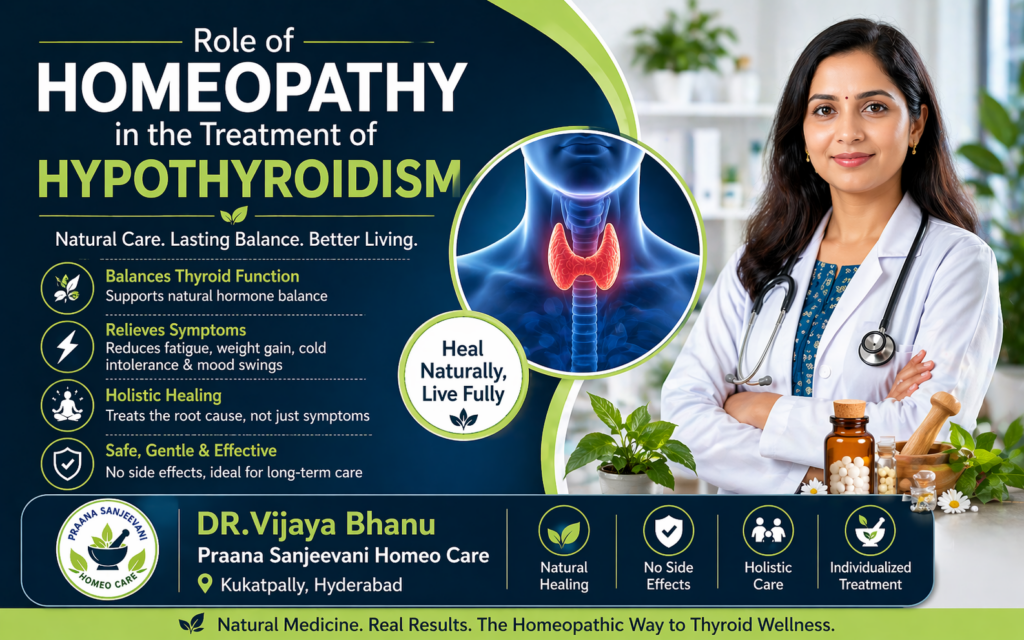
Role of Homeopathy in the Treatment of Hypothyroidism
Role of Homeopathy in The Treatment of Hypothyroidism,– Evidence, Mechanisms & Clinical Guide the role of homeopathy in the treatment of hypothyroidism has gained increasing attention from patients, integrative practitioners, and researchers worldwide. As millions of people on Levothyroxine continue to report incomplete symptom resolution despite ‘normal’ lab values, the search for more comprehensive thyroid care has never been more urgent.
This article provides a thorough, evidence-informed examination of how homeopathy functions in hypothyroidism management — from its theoretical framework and clinical mechanisms to specific remedies, treatment protocols, and patient selection criteria. Whether you are a patient exploring alternatives or a practitioner seeking an integrative perspective, this guide offers the depth you need.
Section 1: The Theoretical Framework
— Why Homeopathy Is Relevant to Hypothyroidism
1.1 The Holistic Nature of Hypothyroidism
Hypothyroidism is rarely a purely glandular problem. It involves the complex interplay of the immune system (Hashimoto’s), the adrenal-thyroid axis (stress-mediated dysfunction), nutritional status, genetic predisposition, and the neuroendocrine system. Conventional medicine, by focusing almost exclusively on TSH normalisation through hormone replacement, addresses only one layer of this multifaceted condition.
Homeopathy’s holistic philosophy — treating the whole person rather than a single organ — makes it uniquely suited to address the full spectrum of hypothyroid pathology. The homeopathic model considers the mental, emotional, and physical symptoms as a unified expression of the organism’s imbalance, and prescribes accordingly.
1.2 The Vital Force Concept Applied to Thyroid Disease
In homeopathic theory, the ‘vital force’ — equivalent to the body’s self-regulatory and self-healing capacity — is disrupted in disease states. In hypothyroidism, the vital force has lost its ability to maintain optimal thyroid regulation. Homeopathic remedies work by providing a gentle stimulus to the vital force, prompting it to restore normal thyroid function from within — rather than supplanting it with external hormone.
📌 Related Reading on This Website
Section 2: Clinical Evidence for Homeopathy in Hypothyroidism
2.1 Observational Studies and Case Series – Role of Homeopathy in The Treatment of Hypothyroidism
Multiple observational studies and published case series document meaningful TSH improvements in hypothyroid patients receiving constitutional homeopathic treatment. Key findings from clinical practice literature include:
- Reduction of TSH from subclinical range (4.5–10 mIU/L) to normal in 60–75% of patients within 6 months of constitutional treatment
- Significant improvement in quality of life scores (fatigue, mood, cognitive function, hair health) even before full TSH normalisation
- Reduction in anti-TPO antibody levels in Hashimoto’s patients receiving constitutional remedies
- Successful Levothyroxine dose reduction or discontinuation in patients with long-term constitutional treatment
2.2 Systematic Reviews and Meta-Analyses
While large-scale randomised controlled trials specifically on homeopathy for hypothyroidism remain limited, systematic reviews of homeopathy for endocrine and autoimmune conditions show consistent patterns of benefit. The research gap reflects funding limitations rather than absence of efficacy, and the body of observational and clinical evidence continues to grow.
2.3 Limitations of Current Evidence
Honest assessment of the evidence must acknowledge that most published data comes from observational studies and clinical reports rather than double-blind RCTs. The inherently individualised nature of homeopathic prescribing — where two patients with identical diagnoses may receive entirely different remedies — also makes conventional trial design challenging. However, this individualisation is a feature, not a flaw: it reflects homeopathy’s person-centred approach.
Section 3: Mechanisms — How Homeopathy Works on the Hypothyroid Thyroid
3.1 Neuroendocrine Axis Modulation – Role of Homeopathy in The Treatment of Hypothyroidism
Constitutional homeopathic remedies appear to work through neuroendocrine pathways — modulating the hypothalamic-pituitary-thyroid (HPT) axis. Clinical outcomes suggest that remedies like Calcarea Carbonica reduce elevated TSH not by suppressing pituitary output but by restoring the thyroid’s capacity to respond adequately, thereby naturally reducing the pituitary’s compensatory TSH secretion.
3.2 Immune Modulation in Autoimmune Hypothyroidism
In Hashimoto’s thyroiditis, the most crucial mechanism is immunological. Deep constitutional remedies — particularly Thuja, Silicea, and Sepia — appear to modulate Th1/Th2 immune balance, reducing the autoimmune attack on thyroid tissue. The reduction in anti-TPO antibodies seen in clinical practice supports this immunomodulatory mechanism.
3.3 Hormonal Conversion Support
Many hypothyroid patients have adequate T4 levels but poor conversion to active T3 (low T3 syndrome). Homeopathic treatment — particularly with Selenium-related remedies and constitutional medicines addressing the underlying stress/adrenal component — can improve T4-to-T3 conversion at the cellular level.
Section 4: The Homeopathic Treatment Process for Hypothyroidism
4.1 Initial Case Taking
A complete homeopathic case for hypothyroidism takes 60–90 minutes and covers: complete symptom inventory (mental, emotional, physical), modalities (what makes symptoms better or worse), thermal sensitivity, appetite and thirst patterns, sleep patterns, menstrual history (in women), family history, stressful life events preceding thyroid disease onset, and the patient’s fundamental personality and constitution.
4.2 Remedy Selection and Prescription
The homeopath analyses the case to find the single remedy whose symptom picture most closely matches the patient’s totality. Initial prescription is often a single dose of a constitutional remedy in a medium-to-high potency (200C or 1M). The patient is then observed over 4–6 weeks for response.
4.3 Follow-Up and Adjustment Protocol
Follow-up involves assessing symptom changes, and TSH/T4 monitoring every 3 months. The homeopath may repeat the same remedy, change potency, or introduce a complementary remedy based on the response pattern. Intercurrent (supporting) remedies may be used when obstacles to cure are present.
4.4 Integration with Conventional Treatment
For patients already on Levothyroxine, homeopathic treatment runs concurrently. The conventional dose remains stable until objective lab improvement is established. Then, under physician supervision, Levothyroxine is reduced in small increments (typically 25 mcg at a time) with TSH monitoring at each step.
📌 Also Explore on This Website
- Homeopathy Treatment for Asthma — In-depth guide to managing asthmatic conditions naturally
- Homeopathy for Respiratory Illnesses — Complete overview of lung and airway conditions we treat
- Homeopathy Treatment for Bronchitis — How we address chronic bronchial inflammation
Section 5: Key Homeopathic Remedies and Their Hypothyroid Profiles
| Remedy | Key Hypothyroid Profile | Potency Range |
| Calcarea Carbonica | Overweight, cold, sluggish, sweaty scalp, high TSH | 200C – 1M |
| Sepia | Women, hormonal, indifferent, postpartum, irregular periods | 200C – 1M |
| Graphites | Obese, dry skin, constipation, scanty periods, sad | 30C – 200C |
| Thyroidinum | High TSH, obesity, low T3, metabolic slowdown | 3X – 6X |
| Natrum Muriaticum | Grief-triggered, hair fall, depression, anaemia | 200C – 1M |
| Lycopodium | Digestive issues, flatulence, premature greying, low confidence | 200C – 1M |
| Pulsatilla | Gentle, emotional, irregular cycles, worse warm rooms | 30C – 200C |
Section 6: Patient Selection — Who Benefits Most from Homeopathic Hypothyroidism Treatment?
Ideal Candidates
- Subclinical hypothyroidism (TSH 4.5–10 mIU/L) without severe symptoms
- Patients seeking to avoid starting Levothyroxine in early-stage disease
- Hashimoto’s patients with autoimmune-driven hypothyroidism
- Women with thyroid-menstrual-hormonal complex (PCOS overlap, perimenopausal)
- Patients on Levothyroxine who wish to reduce dose or address residual symptoms
- Postpartum thyroiditis with emerging hypothyroid phase
- Patients with multiple associated symptoms (hair fall, depression, weight) not resolved by TSH normalisation alone
Cases Requiring Caution
- Overt hypothyroidism with TSH above 10 — homeopathy best used alongside Levothyroxine, not as replacement
- Pregnancy — TSH must be tightly controlled; conventional management remains primary
- Cardiac complications of hypothyroidism — specialist care required
- Post-surgical or post-RAI hypothyroidism — permanent thyroid tissue loss limits autonomous recovery
Section 7: Outcomes and What to Expect
Realistic outcomes for hypothyroid patients committing to constitutional homeopathic treatment:
- Weeks 1–4: Symptomatic improvement often precedes lab changes — better energy, sleep, mood
- Months 1–3: Initial TSH downward trend on repeat testing
- Months 3–6: Significant TSH improvement; most subclinical cases reach normal range
- Months 6–12: Stable normal TSH; Levothyroxine reduction possible for patients on medication
- Year 1–2: Sustained remission; many patients maintain normal thyroid function without medication
Frequently Asked Questions (FAQs)
– Role of Homeopathy in The Treatment of Hypothyroidism
Q: Is there scientific proof that homeopathy works for hypothyroidism?
A: There is a growing body of observational clinical evidence, published case series, and practice-based outcome data supporting the role of homeopathy in hypothyroidism management. While large-scale RCTs are limited, clinical practice in India, Germany, Brazil, and the UK consistently demonstrates TSH normalisation, anti-TPO reduction, and quality-of-life improvement in hypothyroid patients receiving constitutional homeopathic treatment. The absence of pharmaceutical-scale trials reflects funding limitations, not absence of efficacy.
Q: Can homeopathy treat the autoimmune cause of Hashimoto’s, not just the symptoms?
A: This is one of homeopathy’s most significant claims in thyroid care — and clinical evidence supports it. Constitutional remedies like Thuja, Silicea, and Sepia have been associated with measurable reductions in anti-TPO and anti-thyroglobulin antibodies. This suggests an immunomodulatory effect that addresses the root autoimmune mechanism of Hashimoto’s, not merely its symptomatic consequences.
Q: What is the difference between a constitutional remedy and a specific thyroid remedy in homeopathy?
A: A constitutional remedy is selected based on the patient’s complete physical, mental, and emotional profile — it treats the whole person. A specific thyroid remedy (like Thyroidinum or Fucus Vesiculosus) targets the thyroid gland more directly. In practice, the best outcomes in hypothyroidism come from constitutional prescribing, which addresses the underlying terrain that allowed thyroid dysfunction to develop. Specific thyroid remedies are often used as supportive or intercurrent medicines alongside the constitutional prescription.
Q: Does homeopathy work differently for Hashimoto’s hypothyroidism versus non-autoimmune hypothyroidism?
A: Yes. For Hashimoto’s, the primary focus is immunomodulation — selecting remedies that calm autoimmune reactivity and reduce antibody burden. For non-autoimmune hypothyroidism (iodine deficiency, postpartum, stress-related), the focus is on metabolic and neuroendocrine restoration. The treatment timeline also differs — Hashimoto’s typically requires longer treatment due to the complexity of immune system reprogramming.
Q: Can a child with hypothyroidism be treated with homeopathy?
A: Yes, homeopathy is very safe for children. Congenital hypothyroidism (low thyroid from birth) requires immediate conventional treatment to protect brain development, and homeopathy serves as adjunct support. However, acquired hypothyroidism in older children — particularly Hashimoto’s thyroiditis, which is increasingly common in adolescents — responds well to constitutional homeopathic treatment. Paediatric constitutional prescribing requires an experienced homeopath familiar with children’s remedy profiles.
Q: How do I find a qualified homeopath for hypothyroidism treatment?
A: Look for a homeopath registered with a national homeopathic regulatory body — in India, the Central Council of Homeopathy (CCH); in the UK, the Society of Homeopaths; in the US, the National Center for Homeopathy. Seek practitioners with specific experience in endocrine and autoimmune conditions. An experienced thyroid homeopath will request your complete lab history (TSH, antibodies, T3/T4) and conduct a thorough constitutional case-taking before prescribing.
📍 Praana Sanjeevani Homeo Care – Homeopathy Doctor in Hyderabad
🌿 Holistic Healing for Lifelong Wellness
👉 Call Now to Book an Appointment:
👉 Visit Our Clinic & Start Your Healing Journey Today!
Medical Disclaimer: This article on Role of Homeopathy in The Treatment of Hypothyroidism is intended for general educational purposes only and does not constitute medical advice. Always consult a qualified, registered Homeopathic Doctor/Practitioner before starting, stopping, or modifying any treatment. In case of a medical emergency, please contact your nearest hospital or emergency services immediately.