
Homeopathic Medicine Side Effects
Homeopathic Medicine Side Effects, What Every Patient Must Know Every day, millions of Indians turn to homeopathic medicine for conditions ranging from chronic allergies and skin disorders to digestive issues and emotional disturbances. And every day, a common question echoes in clinics across Hyderabad, Mumbai, Delhi, and Bangalore: “Does homeopathic medicine have side effects?”
What This Article Covers on Homeopathic Medicine Side Effects ? We address the clinical science behind homeopathic safety, explain the concept of aggravation, discuss specific situations like pregnancy and childhood, and debunk popular myths — all tailored for Indian patients and conditions.
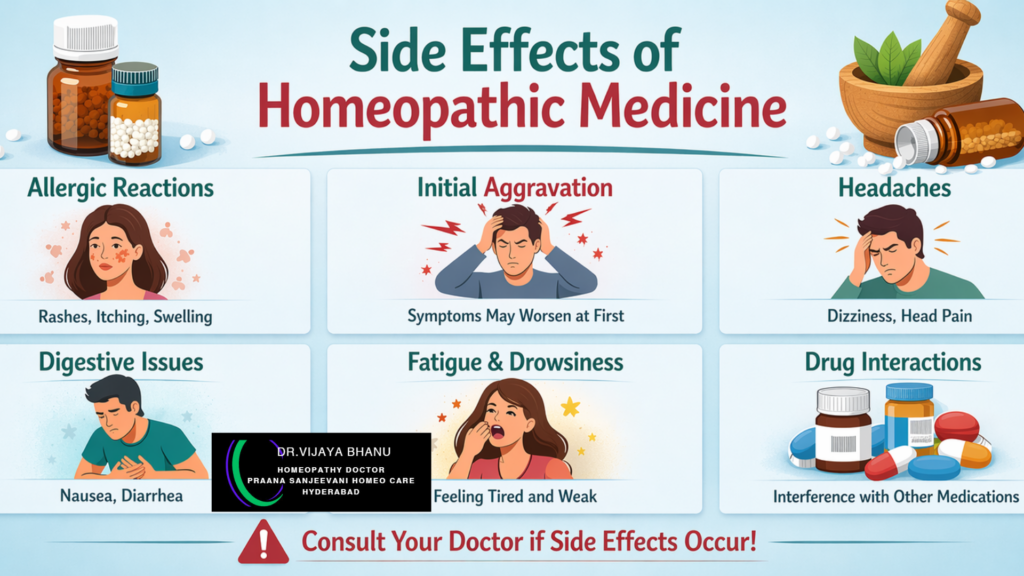
What Are Side Effects in Homeopathy?
In conventional medicine, a side effect is an unintended consequence of a drug — caused by the drug’s pharmacological action on the body. Since homeopathic remedies are diluted to levels where no original molecules typically remain, the question of “side effects” takes on a very different meaning.
In homeopathy, what practitioners call “reactions” to medicines generally fall into three categories:
1. Homeopathic Aggravation (Initial Worsening)
A temporary intensification of existing symptoms considered a positive therapeutic signal. We cover this in depth in the next section.
2. Proving Symptoms (Pathogenetic Effects)
When a high-potency remedy is taken repeatedly without indication, a healthy person may begin to develop symptoms similar to what the remedy is meant to cure. This is called a “proving.” This rarely happens in clinical practice but is a documented phenomenon studied extensively in homeopathic research.
3. Antidoting or Suppression
Taking a remedy that does not match your symptoms may interfere with or delay the action of the correct remedy. This is not a toxicological side effect, but it can slow your healing process.
Undrstanding Homeopathic Aggravation – Homeopathic Medicine Side Effects
Homeopathic aggravation is one of the most discussed — and most misunderstood — concepts in homeopathic practice. It refers to a brief, temporary worsening of a patient’s symptoms after taking the correct remedy.
Why Does Aggravation Happen?
According to homeopathic philosophy, when the similimum (the perfectly matched remedy) is administered, it stimulates the body’s vital force to react strongly against the disease. This heightened reaction can temporarily amplify symptoms before resolution begins.
How Long Does It Last?
A typical aggravation lasts anywhere from a few hours to 72 hours. In chronic cases with deep-seated pathology, it may last slightly longer. Importantly, the patient generally feels better in overall energy and wellbeing even as localized symptoms temporarily intensify.
How Is Aggravation Different From a Side Effect?
| Feature | Homeopathic Aggravation | Drug Side Effect (Allopathy) |
|---|---|---|
| Nature | Temporary worsening of existing symptoms | New, unrelated symptoms |
| Duration | Short-lived (hours to days) | Can be ongoing |
| Sign of | Correct remedy selection | Unintended pharmacological action |
| Action required | Wait; inform your homeopath | Often requires dose change or stoppage |
| Long-term effect | Followed by improvement | Can cause lasting harm if unchecked |
How Safe Are Homeopathic Medicines?
Homeopathic medicines are prepared through a meticulous process of serial dilution and succession (vigorous shaking). By the time a remedy reaches 12C or 30C potency — the most common strengths used in India — the original substance is present at infinitesimally small concentrations.
This extreme dilution is precisely why homeopathic medicines carry a vastly different safety profile from pharmaceutical drugs:
- No organ toxicity: No documented cases of liver, kidney, or cardiac toxicity from properly prepared homeopathic remedies.
- No addiction risk: Homeopathic preparations do not carry the dependency potential seen in opioids, benzodiazepines, or steroids.
- No withdrawal syndrome: Stopping homeopathic treatment does not cause withdrawal symptoms.
- No cumulative toxicity: Unlike heavy metals used in allopathic treatment, homeopathically diluted metals like Arsenicum album or Mercurius solubilis carry no bioaccumulation risk at standard potencies.
Homeopathy During Pregnancy & Breastfeeding – Homeopathic Medicine Side Effaetcs
Pregnancy is a time when women in India are most cautious about medication — and rightfully so. Many conventional drugs carry teratogenic risks or are contraindicated during specific trimesters. This makes homeopathy particularly attractive to expectant mothers.
Is Homeopathy Safe During Pregnancy?
Homeopathic medicines, being ultra-diluted, do not carry the teratogenic or embryotoxic risks associated with pharmacological drugs. They do not cross the placental barrier in the way chemical molecules do. For this reason, they are widely used by homeopathic practitioners worldwide to manage morning sickness, back pain, anxiety, iron-deficiency-related fatigue, and more during pregnancy.
Important Precautions
- Always consult a qualified homeopath — do not self-prescribe during pregnancy.
- Inform your gynaecologist that you are taking homeopathic treatment.
- Avoid high-potency remedies (1M and above) during pregnancy unless specifically prescribed by an experienced doctor.
- Some remedies traditionally avoided in early pregnancy include Sabina, Caulophyllum, and Sepia — these should be used only under close professional supervision.
Safety in Children and Infants
India has a long tradition of using homeopathy for children, partly because parents are wary of the side effects of antibiotics, steroids, and antihistamines in young children. Homeopathic medicines offer a compelling alternative — but must be approached with knowledge.
Why Homeopathy Is Popular for Children
- Sweet sugar globule form makes it easy to administer
- No known toxicity at standard potencies
- Effective for recurrent colds, ear infections, skin conditions, and behavioural issues
- Does not suppress immunity the way corticosteroids can
📌 Related Reading on This Website
- Homeopathy Treatment for Asthma — In-depth guide to managing asthmatic conditions naturally
- Homeopathy for Respiratory Illnesses — Complete overview of lung and airway conditions we treat
- Homeopathy Treatment for Bronchitis — How we address chronic bronchial inflammation
Critical Caution
Drug Interactions: Homeopathy & Allopathy Together
A very common situation in Indian households: a patient on long-term allopathic medications for diabetes, hypertension, or thyroid conditions seeks homeopathic treatment alongside their conventional therapy. Is this safe?
Pharmacological Interactions: Generally Not a Concern
Since homeopathic remedies at standard potencies do not contain pharmacologically active quantities of the original substance, classic drug-drug interactions (like those between two chemical medications) are not expected.
What Can Antidote Homeopathic Remedies
While homeopathic medicines don’t chemically interact with drugs, the following substances are traditionally said to reduce their effectiveness:
| Substance | Effect on Remedy | Guidance |
|---|---|---|
| Coffee | May antidote many remedies | Avoid 30 mins before/after |
| Camphor | Strong antidote (especially topical) | Avoid during treatment |
| Mint / Menthol | May antidote (esp. toothpaste) | Use non-mint toothpaste |
| Strong perfumes | Possible interference | Mild concern only |
| Corticosteroids | May suppress remedy response | Inform your homeopath |
When Homeopathy Can Cause Harm
Acknowledging risk is part of responsible health practice. Here are the real-world scenarios where homeopathic treatment can lead to harm — not from the medicine itself, but from its misuse.
- Delayed diagnosis: Using homeopathy for symptoms that require urgent medical investigation (e.g., unexplained weight loss, persistent cough, blood in stool) can delay life-saving diagnoses like cancer.
- Stopping prescribed medications without supervision: Patients sometimes discontinue insulin, antihypertensives, or thyroid drugs after starting homeopathy, leading to dangerous rebound effects.
- Unqualified practitioners: India has a large unregulated segment of “homeopathy practitioners” with minimal training. Misdiagnosis and inappropriate remedy selection are real risks in this context.
- Heavy metal-containing preparations: Some Ayurvedic-homeopathic combination products contain measurable heavy metals. Always purchase from licensed pharmacies and verify formulations.
- Nosodes in epidemic settings: While nosodes (preparations from disease products) are used as prophylactics in some epidemics, they are not substitutes for scientifically validated vaccines for serious infectious diseases.
Common Myths vs. Facts
❌ Myth
“Homeopathic medicines are just sugar pills with no effect — so they cannot cause any harm.”
✅ Fact
While homeopathic remedies are highly diluted, they have documented therapeutic actions and can cause aggravations or proving symptoms. The sugar vehicle itself is inert, but the energized remedy is not.
❌ Myth
“Homeopathy can cure any disease without any risks.”
✅ Fact
Homeopathy has genuine therapeutic value in many conditions, but it is not a cure-all. Claiming it can treat cancer, HIV, or serious infections alone is dangerous and irresponsible.
❌ Myth
“All natural means all safe — homeopathy is natural so it is completely harmless.”
✅ Fact
Arsenic, belladonna, and snake venom are all “natural” — and dangerous at crude doses. Homeopathy’s safety lies in its dilution process, not merely in naturalness. Self-prescribing crude tinctures is genuinely risky.
❌ Myth
“Homeopathy acts slowly and is only for chronic conditions.”
✅ Fact
Properly selected remedies can act within minutes to hours in acute conditions. Homeopathy is widely and effectively used for acute fever, injuries, infections, and emotional crises.
Tips for Safe Homeopathic Treatment in India
- Always consult a qualified BHMS/MD (Hom) doctor — verify credentials through the Central Council of Homeopathy (CCH) India.
- Provide a complete medical history including all ongoing medications, supplements, and allergies.
- Do not stop allopathic medications without discussing it with both your allopathic physician and your homeopath.
- Keep a symptom diary during the first two weeks of treatment to track changes accurately.
- Purchase medicines from licensed homeopathic pharmacies — avoid unlabeled, unpackaged, or “bulk” remedies of unknown origin.
- Store medicines correctly — away from direct sunlight, strong smells, and electromagnetic devices. Keep at room temperature.
- Inform your homeopath about aggravations — do not self-adjust doses or potencies without guidance.
- Maintain dietary guidance given by your doctor — avoiding coffee, mint, and spicy foods during treatment helps remedies act optimally.
Homeopathic Medicine Side Effects – Frequently Asked Questions ❓
Have Questions About Homepathic Medicine Side Effects?
Consult our certified homeopathic doctors online or in-person across India. Get a personalized treatment plan — safe, evidence-informed, and tailored for you.
📍 Praana Sanjeevani Homeo Care
🌿 Holistic Healing for Lifelong Wellness
👉 Call Now to Book an Appointment:
👉 Visit Our Clinic & Start Your Healing Journey Today!
Medical Disclaimer: This article on Homeopathic Medicine Side Effects is intended for general educational purposes only and does not constitute medical advice. Always consult a qualified, registered homeopathic Doctor/Practitioner before starting, stopping, or modifying any treatment. In case of a medical emergency, please contact your nearest hospital or emergency services immediately.